
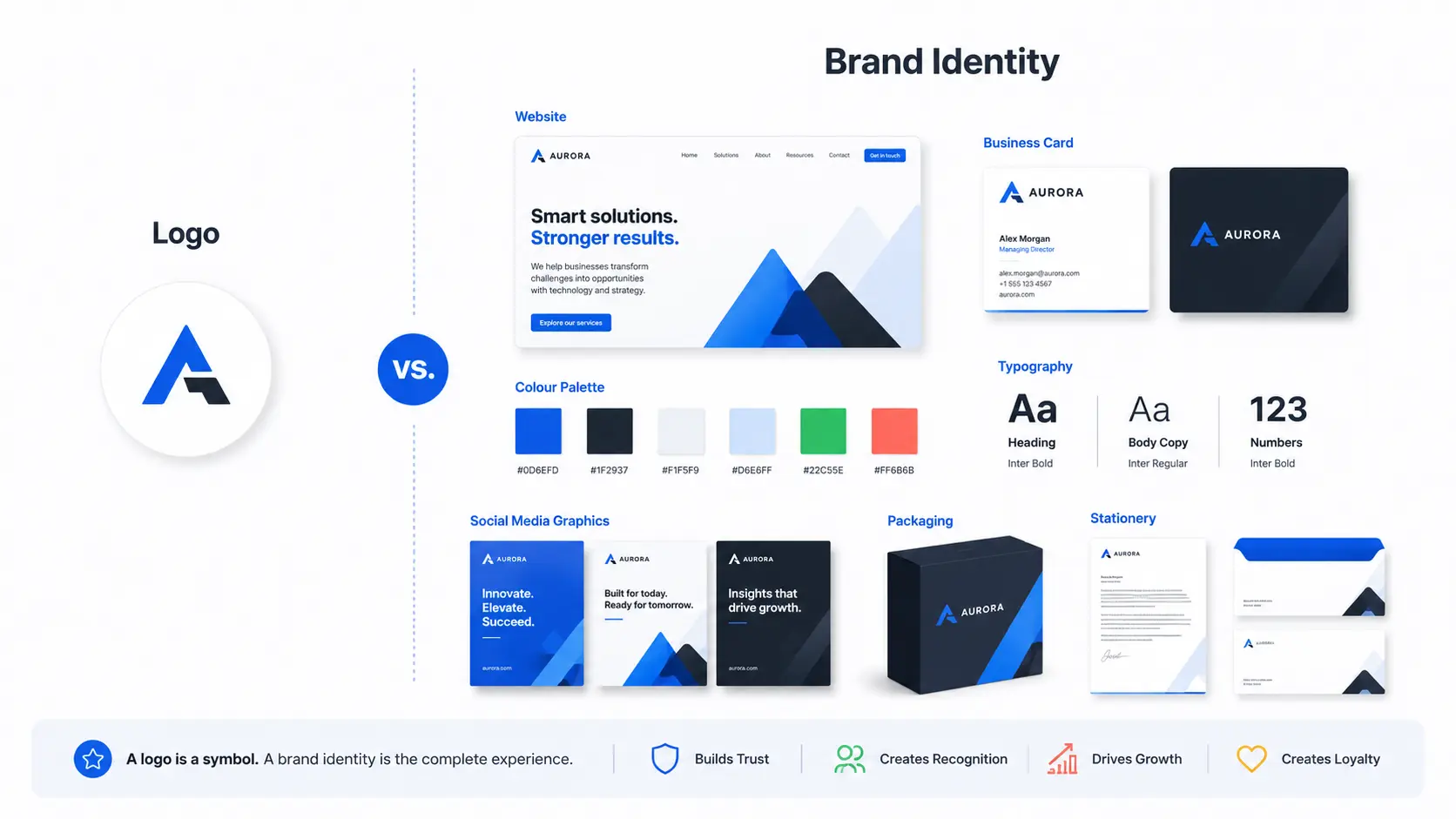
If you're starting a business, one of the first branding decisions you'll face is whether you need a logo, a complete brand identity, or both. Understanding the difference between logo vs brand identity can help you invest your budget in the areas that create the biggest impact.
These terms are often confused, but they serve different purposes. A logo helps customers recognise your business, while a brand identity creates the visual system that helps customers remember, trust, and distinguish your company from competitors.
Before investing in design, it helps to understand how business branding affects customer trust and sales, because customers often form opinions about a business based on how it presents itself.
What Is a Logo?
A logo is a visual symbol that identifies your business. It may be a wordmark, icon, monogram, emblem, or combination of different elements.
Its main purpose is recognition. Your logo gives customers something memorable to associate with your business across touchpoints such as your website, invoices, signage, packaging, and marketing materials.
A good logo should be:
- • Simple
- • Memorable
- • Scalable
- • Relevant to your industry
- • Easy to recognise across different formats
However, a logo alone cannot communicate everything about your business.
Many business owners expect a logo to instantly make their company look professional. While a logo is important, it is only one part of the complete customer experience.
Brand strategist Marty Neumeier explains that a brand exists in the mind of the customer. Your logo contributes to that perception, but the overall impression comes from every interaction customers have with your business.
What Is Brand Identity?
Brand identity is the complete visual and communication system that represents your business. While a logo identifies your company, a brand identity shapes how customers experience and remember it. A brand identity may include:
- • Logo variations
- • Colour palette
- • Typography
- • Photography or illustration style
- • Graphic elements
- • Brand messaging
- • Website design direction
- • Brand guidelines
When these elements work together consistently, your business becomes easier to recognise and appears more professional.
The Ehrenberg-Bass Institute has researched how distinctive brand assets, such as colours, logos, and visual patterns, help customers identify and remember brands. Consistency strengthens recognition because customers repeatedly encounter the same signals.
A brand identity gives your business a system rather than a collection of unrelated designs.
Logo vs Brand Identity: What Is the Difference?
The simplest way to understand the difference is:
A logo identifies your business.
A brand identity expresses your business.
Think about meeting someone for the first time. Their name helps you identify them, but your overall impression comes from their communication style, personality, and behaviour. A logo works in a similar way. It helps customers recognise your business. Your brand identity includes the elements that shape how people perceive your company after interacting with it.
Logo vs Brand Identity: Quick Comparison
Logo
- • A single visual symbol representing your business
- • Focuses on recognition
- • Includes symbols, icons, or wordmarks
- • Helps customers identify your company
Brand Identity
- • A complete visual and communication system
- • Focuses on perception and experience
- • Includes colours, typography, imagery, messaging, and guidelines
- • Helps customers remember and trust your business
Two businesses can have equally attractive logos but create completely different impressions.
One may feel professional because its website, marketing materials, and visual style feel connected. Another may appear less established because every customer touchpoint looks different.
Marketing researcher David Aaker has shown that businesses build brand value through consistent customer associations over time. A logo contributes to these associations, but it cannot create them alone.
Is a Logo Part of a Brand?
Yes.
A logo is one element of your brand identity, and your brand identity supports your overall brand experience. Customers rarely judge a business based only on its logo. They also notice your website design, colours, typography, imagery, messaging, and consistency. A professional logo combined with inconsistent branding can still create a weak impression.
This is why branding should be viewed as a complete customer experience rather than a single design project. If you are building your brand foundation, start with How to Choose a Business Name That Builds Trust and Attracts Customers before investing heavily in visual design.
What Actually Makes a Business Look Professional?
Many business owners assume that a professional logo is what makes a company appear established. From my experience working with small businesses, that is rarely the case.
The biggest branding problems I see are usually caused by inconsistency:
- • Different colours being used across websites, social media, and printed materials.
- • Multiple logo versions appearing across different platforms.
- • Low-quality graphics that reduce confidence in an otherwise good product or service.
These issues may seem small individually, but together they affect how customers perceive your business. Before customers compare your prices or evaluate your services, they are already forming an opinion about whether your business feels credible and professional.
One thing I've noticed from working with small businesses is that a new logo is rarely the solution. More often, the biggest improvement comes from making the existing branding consistent across the website, social media, and marketing materials. Customers don't notice every design detail, but they do notice when a business feels polished and consistent. That's what creates a professional first impression.
When Is a Logo Enough?
For many startups and small businesses, a professionally designed logo is enough to begin. If you are launching with a limited budget, focus on building a strong foundation instead of trying to create every possible branding asset immediately.
A practical starting point includes:
- • A professional logo
- • A simple colour palette
- • Consistent typography
- • A professional website and marketing materials This gives your business a credible appearance without unnecessary costs. As your business grows, you can expand your identity with additional assets such as social media templates, presentations, packaging, signage, and documented brand guidelines.
The goal is not to create everything at once. The goal is to build the right foundation for your current stage of growth.
When Should You Invest in a Complete Brand Identity?
A complete brand identity becomes more valuable when your business needs to maintain consistency as it grows.
Consider investing in one when:
- • Your business is expanding.
- • You are hiring employees or working with different designers.
- • You are launching new products or services.
- • You are investing more heavily in marketing.
- • You are competing with established businesses.
As businesses grow, maintaining consistency becomes harder.
Without clear guidelines, different people may create advertisements, presentations, proposals, and social media graphics using different colours, fonts, or visual styles.
Over time, this weakens recognition and makes the business appear less organised. A documented brand identity helps every customer interaction feel connected, regardless of who creates the content. If you are ready to improve your online presence, explore my Website Design Services to see how professional website design and branding can work together.
Common Branding Mistakes
Thinking a Logo Is the Entire Brand
A logo is important, but it cannot communicate your entire business story. Customers judge your business through the complete experience, including your website, marketing materials, communication style, and customer service.
Changing Your Logo Too Often
Frequent redesigns can make it harder for customers to recognise your business. Strong brands become memorable because they remain consistent long enough for customers to associate specific visual elements with the company. A redesign can be valuable when there is a strategic reason, but changing your logo repeatedly without a clear purpose can create confusion.
Copying Competitors
Looking at competitors can provide useful inspiration, but copying their visual style makes your business blend into the market. Your goal is not only to look professional. Your goal is to become recognisable. A strong identity should reflect what makes your business different.
Final Thoughts
A logo and a brand identity serve different purposes, but they work best together.
A logo helps customers recognise your business. A brand identity helps them remember, trust, and connect with it.
If you're just starting out, you don't need an elaborate branding system immediately. A professional logo, a consistent colour palette, and a well-designed website are often enough to create a strong first impression.
As your business grows, investing in a complete brand identity becomes increasingly valuable because it helps you present your business consistently across every customer touchpoint.
Build a Brand That Helps Customers Trust Your Business
Strong branding isn't about having the most complicated logo it's about creating a consistent experience that gives customers confidence in your business. I help small businesses develop professional brand identities and modern websites that work together to build credibility and attract more enquiries.
Whether you're launching a new business or refreshing an existing one, I'd be happy to help you create branding that looks professional and builds trust. Explore my Branding Services, learn more about my Website Design Services, or contact me to discuss your project.